

Networks & Environments
Choose a network, connect your wallet and check which Fuyu deployment you're using.
Choose your environment#
Start by choosing a Fuyu deployment. The wallet's EVM support is only part of the setup: you also need the chain ID, Pool address and domain, contract runtime hashes, receiving directory, account registry, allowed assets, approved routes and proving files for that deployment. Check that these settings belong together before preparing a transaction.
Ethereum Sepolia is the public development environment. For integration work, the protocol repository also includes a disposable fork of Ethereum mainnet state. That fork copies a historical snapshot into a private chain with its own funds and receipts. Transactions you submit there stay on the fork. The public API currently lists Sepolia as its only supported chain and provides no public local-fork endpoint.
| Environment | Chain ID | Use | Availability |
|---|---|---|---|
| Ethereum Sepolia | 11155111 · 0xaa36a7 | Public development payments, accounts and configured DeFi routes | Public API configuration observed on 2026-10-02; development keys |
| Disposable mainnet-state fork | 31350 | Application and adapter tests against a repeatable fork | Run on Linux; read addresses from the generated config |
| Sepolia-state fork | Read the harness output | Test a Sepolia deployment against copied venue state | Private test setup on a separate chain |
| Ethereum mainnet | 1 | Production Ethereum assets | Mainnet is unavailable in the current app profiles |
| Other EVM testnets and L2 networks | Deployment-specific | Port with its own contract and venue checks | No supported Fuyu profile or contract list in this release |
Check which deployment the app uses#
The API and source use different Pools in the 2026-10-02 snapshot. The public configuration returns 0x83CE32c83913c4637A635c997B161ecCA732c97B. The source revision used for these guides selects 0x8AF98425649a9b9581eAA1E70F25Bab18b2E79Ce for its active Sepolia profile. We found contract code at both addresses through an independent RPC. Each Pool has its own domain, directory and account registry.
The public app's build metadata returned source SHA ced91a5aba786d76c92c17b7718a6048e8a4ee94 during the check. The new source profile therefore isn't enough to tell you what the hosted app is using. Compare the two sets in the contract address reference. Before funding or signing, check that the app's compiled settings match the configuration it receives.
Add Sepolia to a wallet#
Add Sepolia with your wallet's Ethereum network settings, then switch to it. EIP-1193 requests use a hexadecimal chain ID; most wallet settings show the decimal value. Sepolia uses ETH with 18 decimals to pay gas, whichever token you deposit into Fuyu.
The app's network setup uses independent public RPC providers. For ordinary wallet use, a provider needs recent balances, receipts and transaction submission. Account recovery also needs historical contract logs, canonical block hashes and state starting at the deployment block. Check historical access before choosing a recovery node: an endpoint that works for a wallet transaction may restrict older data.
await ethereum.request({
  method: 'wallet_addEthereumChain',
  params: [{
    chainId: '0xaa36a7',
    chainName: 'Ethereum Sepolia',
    nativeCurrency: { name: 'Sepolia Ether', symbol: 'ETH', decimals: 18 },
    rpcUrls: ['https://ethereum-sepolia-rpc.publicnode.com'],
    blockExplorerUrls: ['https://sepolia.etherscan.io'],
  }],
});
await ethereum.request({
  method: 'wallet_switchEthereumChain',
  params: [{ chainId: '0xaa36a7' }],
});
RPC providers and recovery#
The app source lists the public endpoints below. Each provider sets its own quotas and may block requests from some networks. Tenderly worked during the documentation check. Three other listed providers returned HTTP 403 from the verification machine; check them from your own browser before deciding whether you need another endpoint.
Scan historical events in small log ranges and limit your retries. Before validating a deployment, record the chain ID and anchor block. Check the anchor hash again after the scan. If the chain reorganized, reconcile the affected notes or settlements before treating them as final. Your RPC operator can see the addresses and block ranges in these requests.
| Endpoint | Source use | Operational consideration |
|---|---|---|
| https://ethereum-sepolia-rpc.publicnode.com | Wallet network setup | Recent wallet state; provider limits apply |
| https://rpc.sepolia.ethpandaops.io | Wallet setup and recovery | Listed in the app for historical recovery reads |
| https://sepolia.gateway.tenderly.co | Recovery | Independent reads succeeded on 2026-10-02 |
| https://11155111.rpc.thirdweb.com | Recovery | Use smaller log ranges for history scans |
| https://api.fuyu.xyz/rpc | Hosted app RPC gateway | Use an independent node when recovering during an outage |
Handle a network or Pool change#
Use the chain ID and Pool address in cache keys for notes, prepared operations, checkpoints and receiving records. A proof is bound to its Pool domain, and the balance you recover belongs to that Pool. Keep this separation even when a user opens accounts on both Pools with the same access method.
Pause the review if the connected wallet switches networks. Reload the selected configuration and check its contracts, then request a new quote if the route needs one. Keep any authorization you've already released with its original intent and deployment so you can reconcile it there. Switching networks must not rewrite an authorization that could still execute on the original Pool.
Porting to another network#
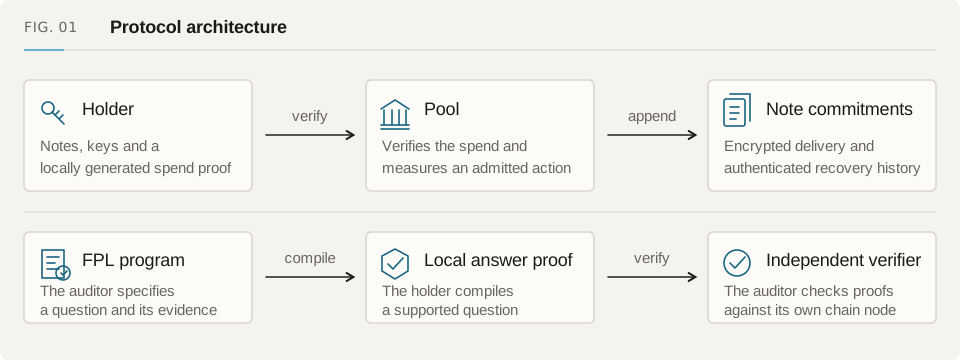
The core deployment script accepts EVM network profiles. To serve a new public deployment, you'll also need an app build that accepts it, runtime admission checks, artifact hosting, a source-policy schedule, a relayer signer and reviews of the external venues. Check every network's token addresses and proxy implementations; matching symbols don't make mainnet, Sepolia and L2 contracts interchangeable.
Create a fresh deployment manifest for each port and run its contract, runtime and browser acceptance checks. Publish the chain settings and recovery bundle before opening it to integrations. Ethereum's network reference explains which testnets suit application development and which suit validator testing. You'll still need a Fuyu deployment on the network you choose.