

Pay wallets with claim links
Send to someone without a Fuyu account, set a claim deadline and recover a claim that was interrupted.
Pay someone before they create an account#
A claim link sends a private note under terms that name a recipient wallet and deadline. Its owner can inspect the payment or claim a public payout without a Fuyu account. Before the deadline, only that named wallet can approve a claim. From the deadline onward, the sender's one-time refund key can authorize a refund.
Send the link privately and keep the original. It contains the material needed to inspect the payment and recover an encrypted claim authorization. The app puts it in a URL fragment, which is not included in an ordinary HTTP request. Anyone you give the full link to can still read the payment information it contains, although spending requires the right approval.
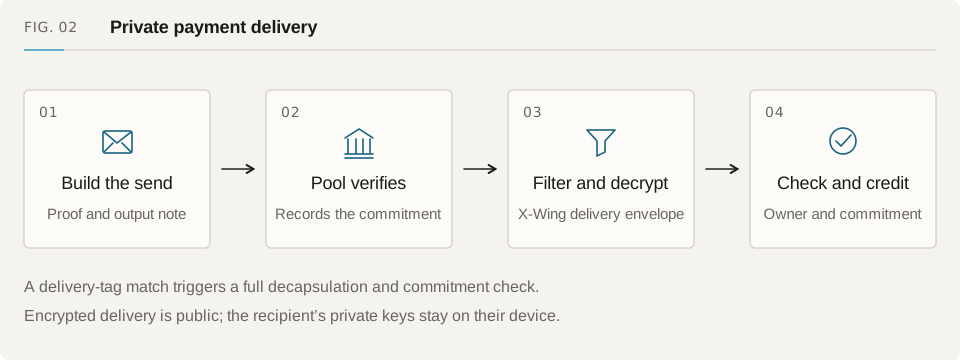
Create and send a claim link#
Open Claim links in your private account. Choose an eligible non-native asset, enter the recipient's full wallet address and set a deadline. Review the amount, change, claim terms and any wallet approval needed. The send accepts at most two input notes. Use Combine first if your amount needs more.
Generate the proof, collect wallet B or Safe approval if configured, and submit once. Wait for the app to confirm the payment from Pool history before sending the link. The sender flow requires at least a one-hour margin before the deadline. Copy the funded link to the recipient and keep the sent-link record so you can check it or refund after expiry.
Check the payment and choose where it goes#
Open the link in the configured app and connect the named recipient wallet. Choose Check payment in the Pool. The app reads authenticated history to find the funded note; the asset and amount written in the link are only hints. If nothing is found, check whether the sender's transaction has landed, whether you opened the right deployment, or whether the note was already used.
Choose a public wallet payout or receipt into an open Fuyu account. A public payout reveals the token, amount and wallet and may deduct a relay fee. Private receipt keeps the output amount private and is sponsored. Public receipt needs a positive net payout. If a fee-tier calculation leaves an extra remainder, you must separately agree to pay it as fee.
| Destination | Before claiming | What you receive |
|---|---|---|
| Named public wallet | Connect and sign with the named wallet | The public net payout after its fee |
| Private Fuyu account | Open the destination account and sign with the named wallet | A private note in that account |
| Sender refund after expiry | Open the sender's refund authority | The app returns funds privately under the original terms |
Sign the claim and check its result#
The browser prepares the proof, then the named wallet signs a typed approval for that claim. The relay can deploy the claim controller and submit it, so the recipient wallet signs without paying those gas costs. Before deployment or submission, the app stores the signed authorization in encrypted local storage.
Deploying the controller publishes the recipient wallet, Pool, deadline and one-time refund address. The refund address is not the sender's funding wallet. Recipient and amount stay hidden at the initial private send. Claiming into a private account keeps the output value private; paying a public wallet publishes it.
Leave time to claim#
The app refuses a new claim in the last ten minutes before its deadline, leaving time to prove, sign and relay. Retrying a saved authorization requires at least sixty seconds. After the deadline, the recipient cannot claim and the sender can use the refund flow.
A claim spends the whole claim note at once, with no change note. After expiry, the sender's refund key can authorize a destination without the original account's wallet B. Explain that authority change if you create claim links from a controlled account.
Use public escrow when the payment can be public#
Some deployments also provide a public escrow for an unregistered 0x recipient. It uses money in the connected public wallet rather than private notes. Token allowance, opening, claiming and refunding are ordinary public transactions. The funding wallet, recipient, amount, token, deadline and fixed refund wallet are all public.
Only the recipient can claim before the deadline. From the deadline onward, anyone can trigger a refund to the fixed refund address. Keep the payment reference and check chain receipts if opening is uncertain. This flow needs its own deployed escrow, transaction-enabled build and wallet gas. Use a private claim link when you need its privacy properties.
Recover a claim that stopped midway#
If submission is uncertain, choose Check claim or refund onchain. Keep checking before making another proof: the original authorization may still execute. The saved-claim review can resubmit its original proof and signature with the same destination, amount and fee. It checks the claim window, controller, Pool and relay fee first.
To continue on another device, keep the private link and an exported encrypted pending-claim backup, or enable the optional encrypted backup service. Chain history cannot restore a signature that was never broadcast. If the saved fee no longer covers the relay requirement, the app refuses to retry. It will not change the proof or ask for a replacement signature without a new review.